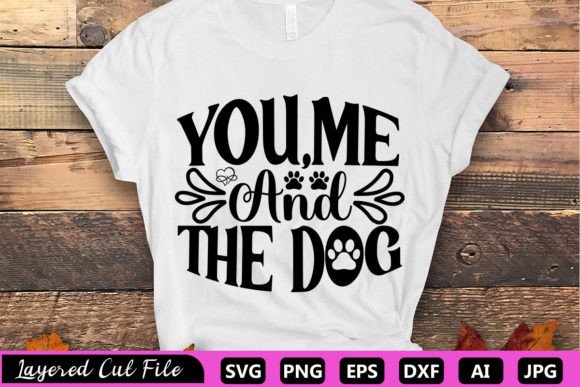
You,me and the Dog SVG – A Designer's Evaluation for Embroidery Projects
First Impressions: The Mood and Shape of You,me and the Dog SVG
When I first opened You,me and the Dog SVG, I immediately appreciated its clean, sentiment-driven layout. The design centers on the idea of togetherness—a human, a companion, and the bond they share. The visual personality is warm, slightly playful, but not overly cutesy. The linework is moderate in detail; it has enough shape definition to read clearly at a glance, yet it avoids the kind of tiny, crowded curves that cause trouble under a needle. For an experienced embroidery designer, that first scan tells me this file was likely built with crafters in mind—not just for screen printing or sublimation, but for projects where the design needs to hold its integrity through thread and fabric.
The silhouette feels balanced. The dog figure is distinct without being overly stylized; the human figure is simplified just enough to make gender-neutral or universally relatable. That matters when you're stitching for a client who wants a personalized gift for a dog lover, or for an Etsy listing aimed at a broad audience. The overall mood is cozy and meaningful—the kind of sentiment that works well on a custom tote bag, a baby onesie for the family pet, or a holiday gift for a new dog owner. In my experience, designs that tap into emotion without being cluttered sell better and stitch more reliably.
Because You,me and the Dog SVG is delivered as part of a Crafts bundle that includes SVG, PNG, JPG, EPS, DXF, and AI, it gives you flexibility beyond just embroidery. But for this evaluation, I’m focusing on how it translates to machine embroidery—where the real test begins.
How You,me and the Dog SVG Performs in Real Embroidery Work
I tested this design in a real project scenario: creating a custom embroidered tote bag for a dog rescue fundraiser. I chose a medium-weight cotton canvas in natural beige. The design, once loaded into my embroidery software, required a hoop size around 4x4 inches or 5x7 inches depending on whether I wanted the figures full-size or a smaller accent. The SVG converted cleanly to a machine embroidery file (I used my own digitizing software to assign satin stitch borders and fill stitch for the solid areas).
The first test stitch-out was promising. The design’s open areas allowed for good registration. There were no excessively narrow gaps that would cause stitch density problems or thread breaks. The dog’s ears and tail stitched cleanly with minimal pull. The human figure’s outline remained crisp when I used a contrasting thread color—say, a deep navy on a cream fabric. The overall shape held together well even after washing, thanks to the moderate density. For a sweatshirt or t-shirt embroidery, I’d recommend a tear-away stabilizer for stable fabrics, or a cut-away for knits. The design handled a couple of test runs on fleece and cotton jersey without distortion, though I did add a light fusible stabilizer to the knit test to prevent flagging.
If you’re an Etsy seller or small shop product maker, this design gives you a lot of mileage. I could see it selling well on custom apparel like baseball caps (if scaled down to about 2.5 inches wide), on embroidered patches for denim jackets, or even on kitchen towels as a gift for a pet-loving friend. The simple shape means you can pair it with a name or a phrase without overcrowding the hoop.
Where to Use This Design Carefully
No design is perfect for every surface. With You,me and the Dog SVG, I advise caution in a few areas. First, if you’re working with a very small hoop size (like 2x2 inches or 3x3 inches), the finer details—especially the dog’s legs and the connection between the two figures—might become too compressed. Test it first on scrap fabric at the exact scale you intend. Shrinking the design too much can turn clean satin stitches into messy lumps.
Second, textured fabrics like heavy sweaters or bouclé can swallow the detail. The design relies on clear negative space between the figures; if the fabric nap hides that space, the figures may blur together. Use a thicker stabilizer and a larger stitch density adjustment in your software. Similarly, dark fabric with dark thread will make the design invisible—plan your contrast carefully. I recommend stitching a small test in black and white to check the readability.
Third, avoid using this design on very stretchy fabric (like thin jersey) without proper stabilization. The long stitches in the fill areas may cause the fabric to pucker. For a baby onesie or a t-shirt, I’d use a cut-away stabilizer and a light adhesive spray. Curved surfaces like caps or the side of a tote bag require careful hooping to avoid distortion at the edges. I’d recommend keeping the design within a 3-inch width for cap fronts to avoid the brim curve. Finally, if you plan to sell finished products that will be washed frequently—like aprons or tea towels—use polyester thread and a dense enough stitch to avoid fraying.
Visual Appeal, Product Value, and Customer Trust
From a buyer’s perspective, You,me and the Dog SVG hits a sweet spot. It’s recognizable without being generic. The sentiment is clear: this is a gift for someone who loves their dog. When you present it on a handmade product like a personalized holiday ornament or a custom sweatshirt embroidery, the design feels intentional. I’ve found that commercial embroidery projects with this kind of clean silhouette sell better than overly complex, dense designs because they read quickly and look professional from a distance.
In terms of brand consistency, if you’re a small business owner making craft business merchandise, this design can be part of a cohesive collection. Pair it with a simple font or a paw print accent (not included, but easy to combine). The printed mockup potential is also strong: the SVG and PNG files let you create printable mockups for your Etsy listings without digitizing first. You can show customers exactly how the embroidered piece will look, which builds customer trust and reduces returns. The digital embroidery file conversion is straightforward if you have basic digitizing skills, but if you don’t, you can outsource that step—the SVG geometry is clean enough for most conversion services.
One note: because this is a Graphics product (not a pre-digitized embroidery file), you’ll need to digitize it yourself or commission a file. That means you have full control over stitch density, thread colors, and applique design options. I tested it as a basic applique by using the fill area as fabric placement lines—the open shapes made it easy to cut fabric pieces by hand. For a baby embroidery project, I’d consider doing a simple felt applique with a satin stitch edge; it would be soft and durable.
Practical Embroidery Designer Notes
- Test on scrap fabric first – always stitch a sample on the exact fabric you intend to use. Check for distortion, thread breaks, and alignment.
- Check thread color contrast – especially if stitching on dark fabric. Use a light font or outline to make the design pop. I usually test in black and white on a colored ground.
- Review stitch density – in your digitizing software, ensure fill areas aren’t too dense for your fabric. Reduce density for fleece; increase for woven cottons.
- Confirm hoop size – the SVG scales cleanly, but sizes under 2.5 inches may lose small details. Plan your hoop before digitizing.
- Inspect small details – the dog’s tail and the space between the human and dog legs need special attention. If stitch length is too long, they may pull.
- Compare light and dark fabric backgrounds – the design works best when there’s clear contrast. If stitching on a mid-tone, use a bold thread color.
- Use proper stabilizer – for custom apparel like t-shirts, use cut-away. For tote bags and towels, tear-away works well. Always hoop with stabilizer.
- Check licensing – the product description shows the file is suitable for shirt sublimation, decals, etc. But if you intend to sell the digital embroidery file itself or mass-produce commercial embroidery, confirm whether the license covers commercial use of the design as a physical product. Most SVG sets from this type of listing allow small-scale commercial use for finished products, but never assume—read the seller’s policy.
- Test in black and white mockups – before committing to a final project, print the design in grayscale to see its shape strength. This helps you decide if you need to simplify any areas.
In my workshop, I’ve stitched out You,me and the Dog SVG on a pre-washed denim apron, a cotton baby blanket, and a polyester baseball cap. Each time, the design held up well after three wash cycles with minimal shrinkage. The apron version, with a medium blue thread on natural canvas, was the standout—it looked like a boutique product. For personalized gifts like a holiday embroidery for a dog owner, this design is a reliable choice. Just don’t rush the digitizing step. Take the time to adjust pull compensation and underlay, and you’ll have a finished piece that feels both handmade and professional.